
Convivial Tables: INVISIBILE — Spore, parole, correnti. Interview with Bogiaisso

Now in its fifth edition, Convivial Tables continues to explore food as a cultural, ecological and relational practice, broadening the debate on the forms of coexistence between human beings, ecosystems and the infrastructures that sustain everyday life. Part of the Eating stream at TBA21–Academy's Ocean Space, the research program weaves together art, ecology and situated knowledge, inviting audiences to question the geographies, gestures and networks – often invisible – that shape our relationship with the territory.
The 2026 edition, INVISIBLE — Spore, parole, correnti (Invisible - Spores, Words, Currents), curated by Bogiaisso (Niccolò Moronato and Alice Jasmine Crippa), takes as its starting point an element as ordinary as it is revealing: the “schiscia” – the packed lunch prepared at home and eaten during the working day.
Eaten out of sight, on building sites, on boats, or in the city’s service spaces, the “schisce” speak of invisible geographies, work rhythms, and forms of belonging that rarely find space in the story of Venice.
Through four journeys in small boats across the Lagoon, a path of shared poetry, and a network of collaborations including Orchestras of AWEdacity (Kayla Archer), Fie a Manetta, and numerous guests, the program allows itself to be guided by the perspectives of those who traverse Venice, the people who build it and keep it alive every day.
We asked Bogiaisso to tell us how INVISIBLE came about, what kinds of encounters shaped its path, and what it means today to observe a city starting with the things that usually stay out of frame.
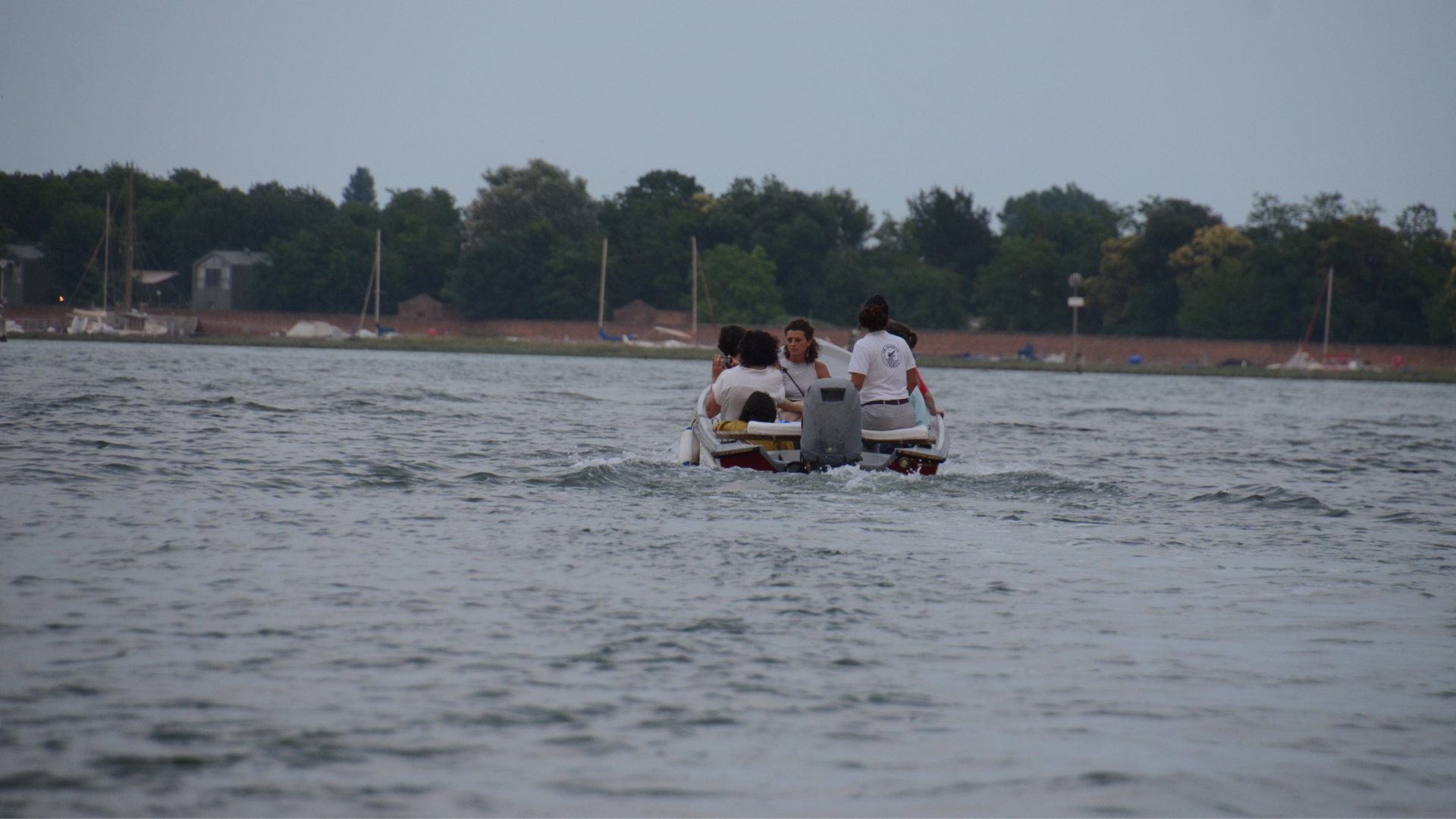
Within TBA21–Academy’s Ocean Space research into the relationship between ecology, food, and bodies of water, Convivial Tables is a program that, over the years, has welcomed different perspectives through the work of artists, researchers, and curators (Barena Bianca, TOCIA!, Chiara Famengo, The Tidal Garden). What does it mean for you to join this journey in its fifth edition, and how did you choose to engage with the research carried forward by previous editions?
We approached it with respect and a question: what can someone from Chioggia, at the southern tip of the Lagoon, bring to a program that has previously operated primarily from Venice? The answer we found was: a different perspective on what remains invisible to most people. Previous editions explored seaweed, submerged ecosystems, food practices linked to water. We wanted to add another layer: the human labor that sustains the city, the everyday gestures that almost no one sees, the geographies that don’t appear on any maps. Not a change of direction, but an extension. From submerged ecologies to social ecologies. From seaweed to the lunchtime “schisce”.
Bogiaisso was born from a process of listening to the fishing community of Chioggia, at the southern tip of the Venetian Lagoon, starting from practices and knowledge that are often little seen. What kinds of encounters, stories, or gestures that emerged over time changed the way you look at the Lagoon?
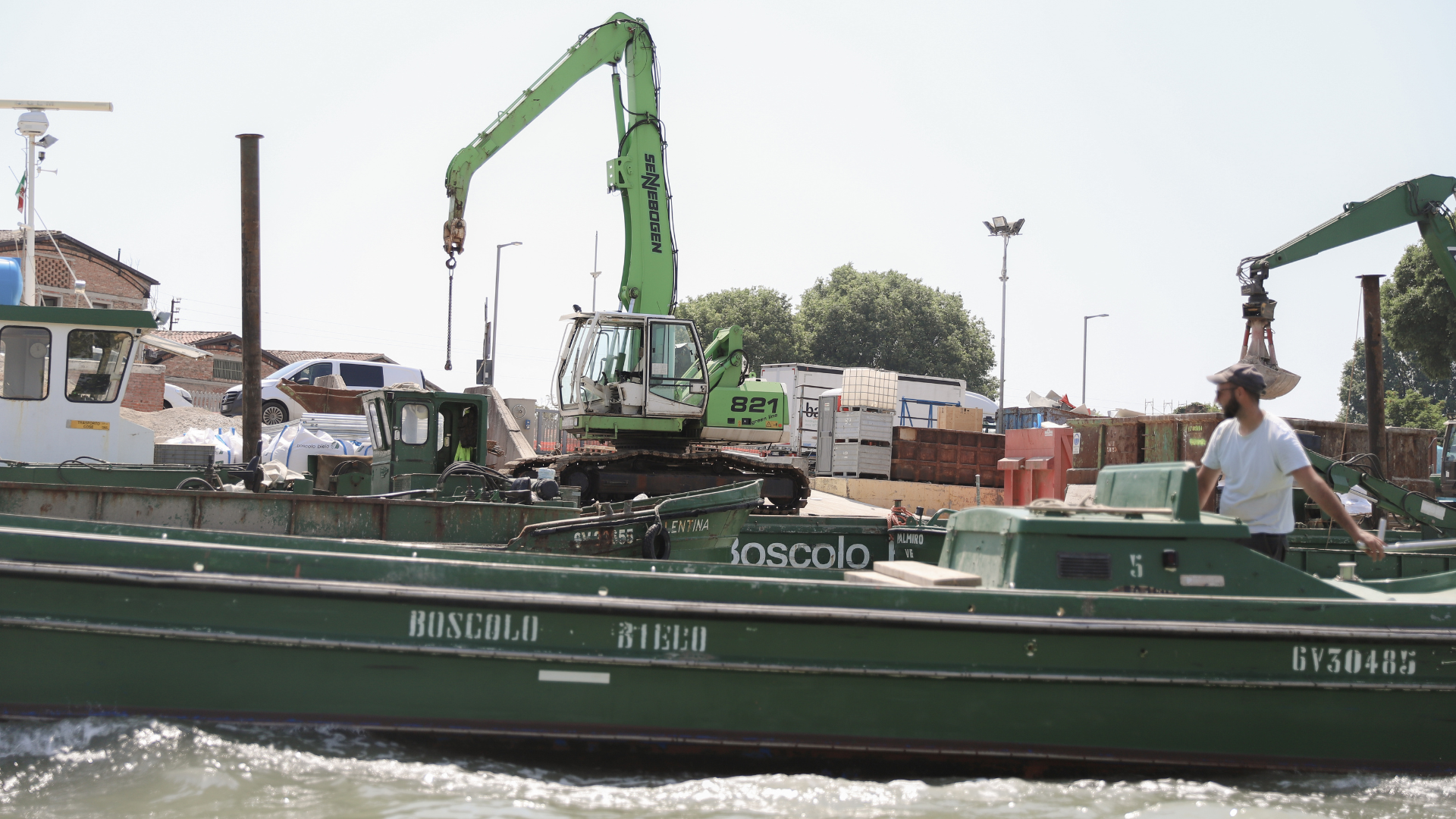
In Chioggia, we learned that knowledge cannot be extracted or applied to the letter: it is inhabited. You don't go to “collect stories”, you stay, you listen, and at a certain point, someone tells you something because they trust you. That changed everything. We stopped looking for content and simply started “being”. That formed a way of looking that we brought to Venice: not to search for the invisible, but to put ourselves in the conditions where the invisible reveals itself. To follow the rhythms of the people who work, not the people who visit. To go out at 10 in the morning with the green garbage-collection boats, not at 6 in the evening.
If you had to tell the origin of INVISIBLE through a single image, what would it be? What did you begin to see in the Venetian Lagoon – a person, a gesture, a place, a practice – that had previously seemed invisible and that gave shape to the program’s imagery of spores, currents, words, and languages?
A man sitting on the bow of a work boat, stopped in an internal canal, eating meatballs with the previous evening’s “peperonata” at 11 in the morning. No one looks at him. He looks at no one. It’s a moment that doesn’t exist for Venice — it’s not photographable, it’s not "Instagrammable", it’s not monetizable. And yet it is Venice. It’s the work that keeps it standing. That man and that “schiscia” became the center of INVISIBLE: working meals and the places where they are eaten. From there, everything else opens up — the routes, the rhythms, the geographies that appear on no map.
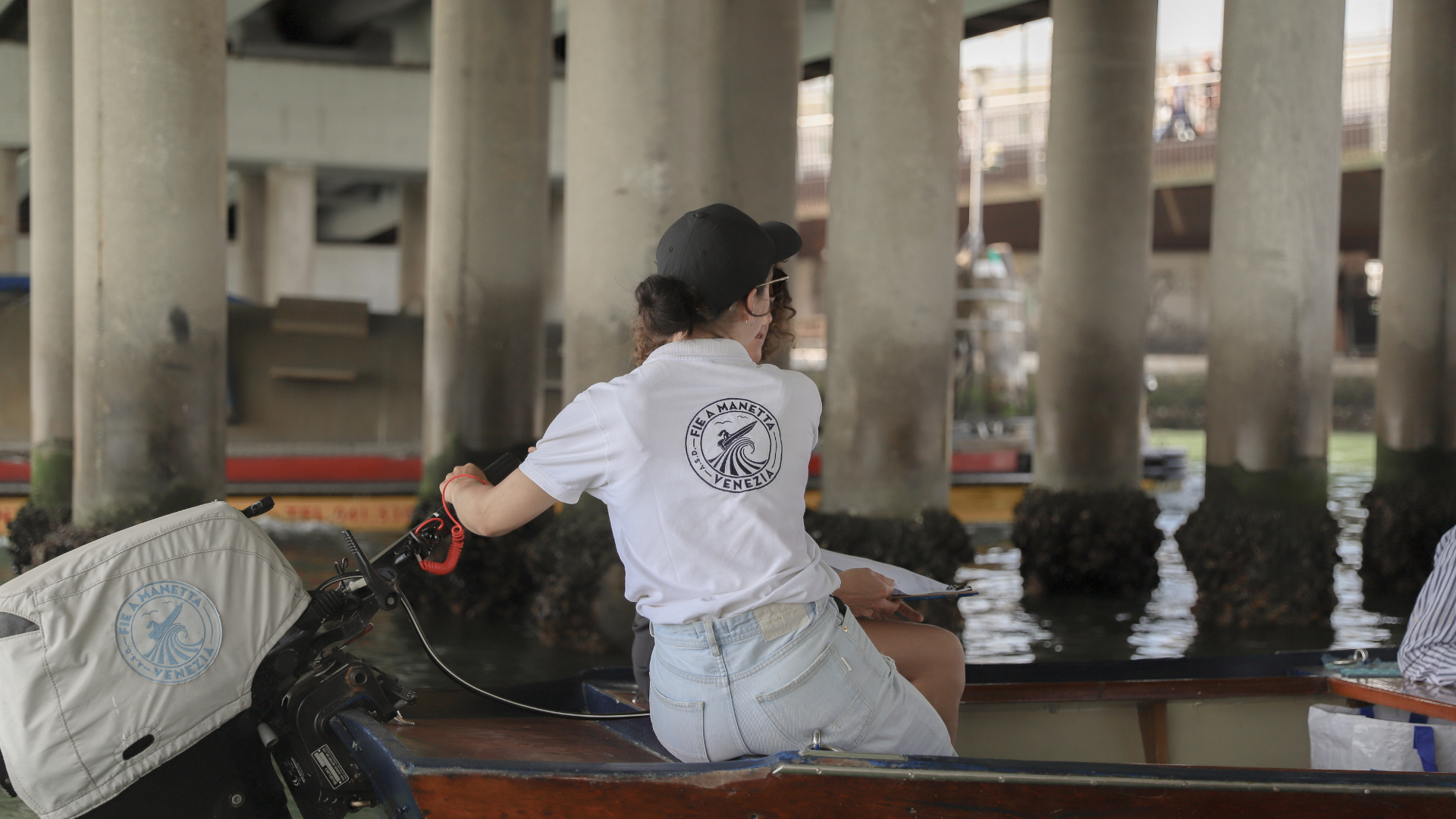
The four small-boat journeys follow routes that rarely appear on maps of the better-known Venice (from Sacca Fisola, following the garbage-collection boats and the geographies of the “schisce”, to Tronchetto and Piazzale Roma, crossing the infrastructures that supply the city; from the invisible ecosystems of spores, molds, and fungi between the Arsenale and the Lagoon, to the Isola delle Rose – Sacca Sessola – and its stories of memory, rights, and resistance). How did you build these itineraries?
We didn’t ask Marta Canino of Fie a Manetta to “take us here”; instead, we told her what we were looking for: unresolved tensions experienced in Chioggia, impressions perceived and discussed with workers in Venice, open questions, not answers. She listened and translated all of this into itineraries, guided sightings, and points of observation that we would never have found on our own.
It was kind of magic: it was never what we expected, every time she took us to places we didn’t know, or that we knew but had never looked at in this way. Bare, true, urgent points of view. Not spectacular, but real.
We didn’t design itineraries: we shared questions, which Marta of Fie a Manetta – with her deep knowledge of Venice – was able to turn into routes. It’s a collaboration we’re particularly proud of.
To cross the Lagoon, you chose to collaborate with Fie a Manetta, the first motorboat school run by women. Why is this collaboration important for INVISIBLE, and how has their way of piloting influenced the program?
The way you pilot a boat changes what you see. Fie a Manetta pilot slowly, respectfully. They pilot from the point of view of those who defend Venice, work it, and live it. It’s not the gaze of those who consume Venice, it’s the gaze of those who protect it, honor it, and teach others to slow down.
From that point of view, the invisible reveals itself. You see the work boats, not the gondolas. You see the rhythms of those who supply bars and businesses, not the people visiting. You see the places where you eat a “schiscia”, not where you pay a cover charge.
Fie a Manetta taught us that speed is an ideology. Slowing down is not a luxury, it’s a political position. It’s the first step to discovering the language of Venice, its pains, its paradoxes. INVISIBLE wouldn’t have been possible without that way of “being” on the water.
The “schisce” are among the most unexpected protagonists of INVISIBLE. Why did you choose to start precisely from a meal eaten out of sight? What can a “schiscia” tell us about everyday life in the Venetian Lagoon and the people who keep it alive every day?
The “schiscia” represents the moment when work stops but doesn’t disappear. It’s the moment when the worker claims a space — even just ten minutes on a “fondamenta” (the canalside), a corner of a boat, or a step. It’s an intimate gesture that no one talks about. Venice is full of stories about food: cicchetti [venetian tapas], fritto misto [mixed fried seafood], and historic restaurants. But who talks about stuffed calamari eaten standing up at 7 in the morning? Who explains the geographies of the people who never put their legs under a table? The “schiscia” allowed us to enter those geographies. Not as observers, but as lunch companions.
In INVISIBLE, language doesn’t seem to be just a tool for communicating, but also a way of inhabiting a place. Venetian, Chioggiotto, Arabic, English, Spanish, and many other languages intertwine in the program: what happens when dialects, mother tongues, translations, and words that not everyone understands coexist in the same space?
What happens is that no one understands everything. And that’s the point. When Wissal talks about Aïta, when someone uses a word in “ciosoto” [the Chioggia dialect], when Kayla brings the Calypso, not everything is translated, not everything is explained. And that’s fine. Partial incomprehension is not a failure, it’s a form of respect. It acknowledges that every language carries a world that can’t be fully transferred. In INVISIBLE, we chose not to always translate, but to leave room for incomprehension too, without experiencing it as a problem. Often, it’s precisely what we don’t fully understand that sparks curiosity and the desire to get closer to something that, until that moment, we didn’t even know existed.
Not having everything clear, in fact, sometimes leads to a desire to have experiences that no longer let you see that reality from the outside, but from within. Curiosity, the unresolved, the unexplained are, for us, fundamental tools for overcoming otherness and indifference. In the silence full of questions of those who don’t fully understand, there is a welcome and a humility towards the other that we place at the center of our practice.
With Orchestras of AWEdacity, you introduced a practice of collective writing inspired by Caribbean Calypso. What attracted you to this method, and how did it transform once it landed in the Venetian Lagoon?
Calypso, the “evil twin” of Caribbean Carnival, was born as a practice of resistance: a way of speaking truth in public through characters, masks, and alter egos. In INVISIBLE, this became giving voice to those who don’t usually speak, but without speaking on their behalf. We used objects, the crane of the transport boats, the black snake of the sewage boats, the stuffed crocodile mascot of a garbage boat, the delivery worker’s wheelbarrow, as characters through whom participants could speak about work, exhaustion, and anger, without having to expose themselves directly. It’s a trick as old as Venice: the mask liberates. In the lagoon, with its burden of silences and hierarchies, this trick worked. People wrote things that, perhaps, they would never have said in their own name.
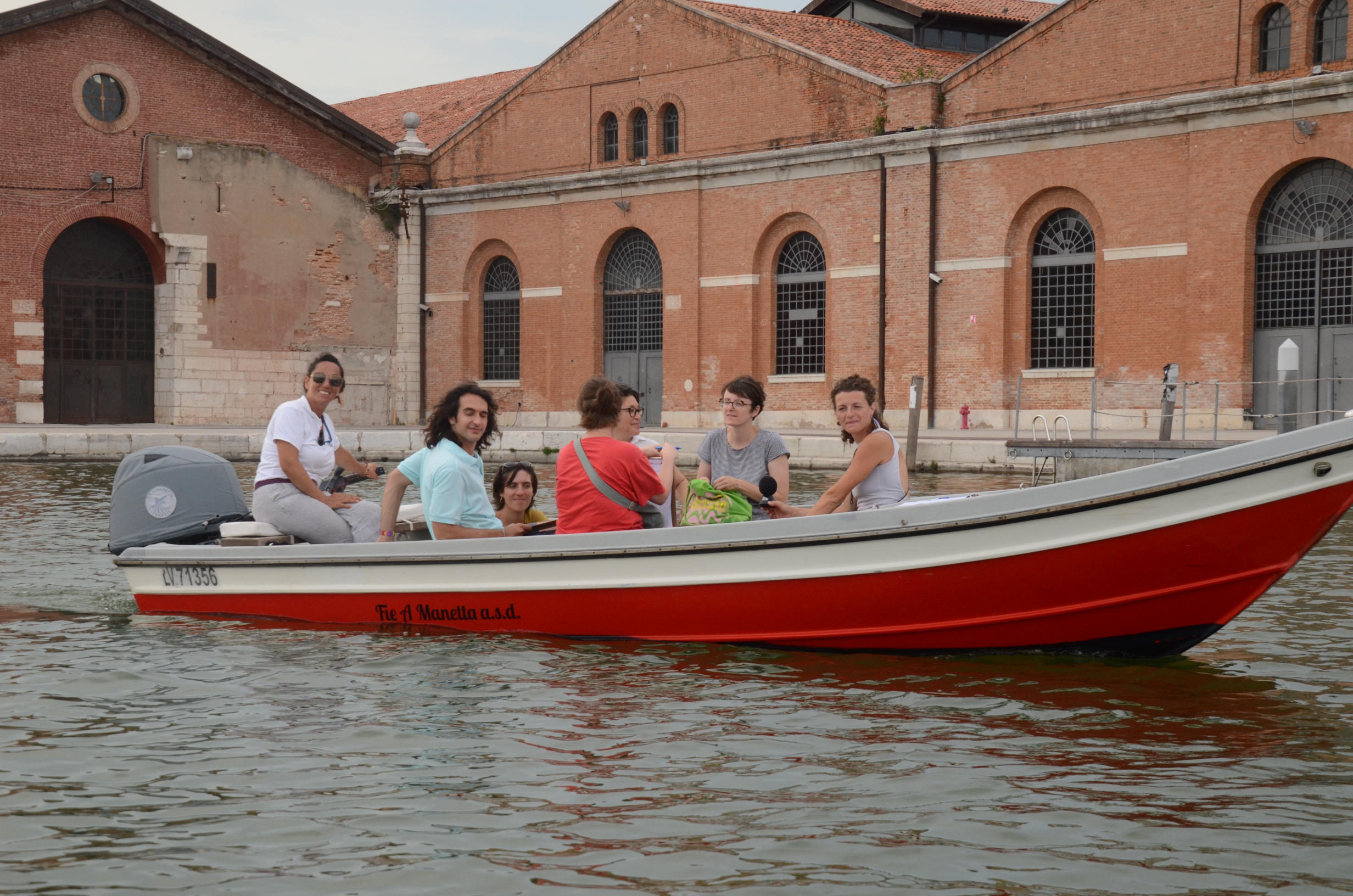
What kind of community has formed around INVISIBLE? With the program almost over, what is the anecdote or exchange between participants, lagoon workers, artists, and guests that you keep telling because it captures the spirit of the project?
Community is a delicate word that we use with great respect and caution. It’s certainly a group of people who wanted to take part in the program, who crossed paths four times on a boat, and who in September will meet again to eat together in Campo San Lorenzo. Some saw each other again between one trip and the next, others didn’t. But there’s something that binds them together: they saw Venice from a point of view they didn’t know, and that alone, for us, changes something.
More than an anecdote, the thing that stays with us is an image that, for us, represents the many “punk” solutions devised by Venice’s workers to deal with its planned inefficiencies.
If you go under the final stretch of the Ponte della Libertà, where the roads to Piazzale Roma, Santa Marta, and Tronchetto meet, you’ll find yourself in the “no-man’s-land” where the work boats pass through. There, dozens of tall ladders line up, propped between the mooring docks and the walls of the bridge. It’s the only way for workers to reach their boats – a precarious method, an improvisation that has become standard practice. If, passing by, you happen to see someone emerge from under the bridge and walk along the edge of the road, know that this is where they’ve come from.
The anecdote we keep telling is this: during one trip, a Venetian participant said, “I have no sense of direction, but in Venice I can never get lost.” It sounded like a compliment, but it was a complaint. Venice is a city where every route seems already mapped out. It’s so marked, so signposted, that getting lost has become almost impossible. From that reflection came one of the questions that guided the whole program: how do we reclaim the right to get lost in a city that once thrived on hidden passages, detours, and invisible geographies?
REPOWER
Long active in developing electric mobility solutions for both land and water, Repower has chosen to support the fifth edition of Convivial Tables as its Electric Mobility Partner, sharing a commitment to a more livable lagoon that respects the environmental balance sustaining it. The collaboration with Ocean Space stems from a shared desire to open up spaces for reflection on the possibilities of a more sustainable future for Venice, fully aligned with the ecological values that inspire Convivial Tables.

