
Unearthing Networks of Power
Federico Pérez Villoro, Ocean-Archive.org’s 2025 Digital Resident, on submarine investigations into the cost of connectivity

The internet’s invisible infrastructure is carving a physical and political toll into the planet. Submerged in the ocean, the network of fiber-optic cables that enables ceaseless connectivity for a part of the world is also complicating access to water, altering biodiversity, and reinforcing historical inequalities, often in places already marginalized by geopolitical and economic forces. Yet the precise locations of the cables remain secret, mainly controlled by governments and corporations.
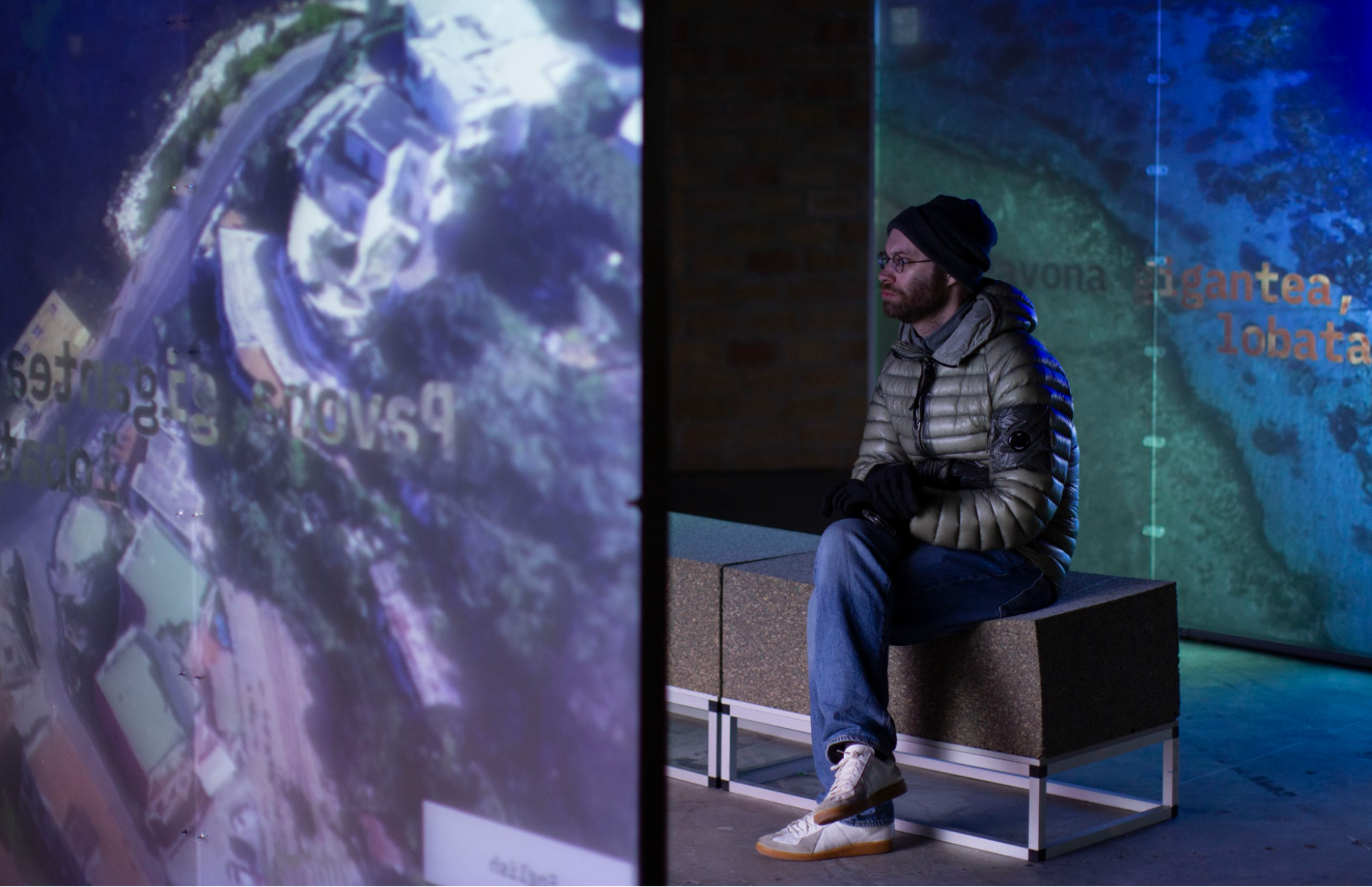
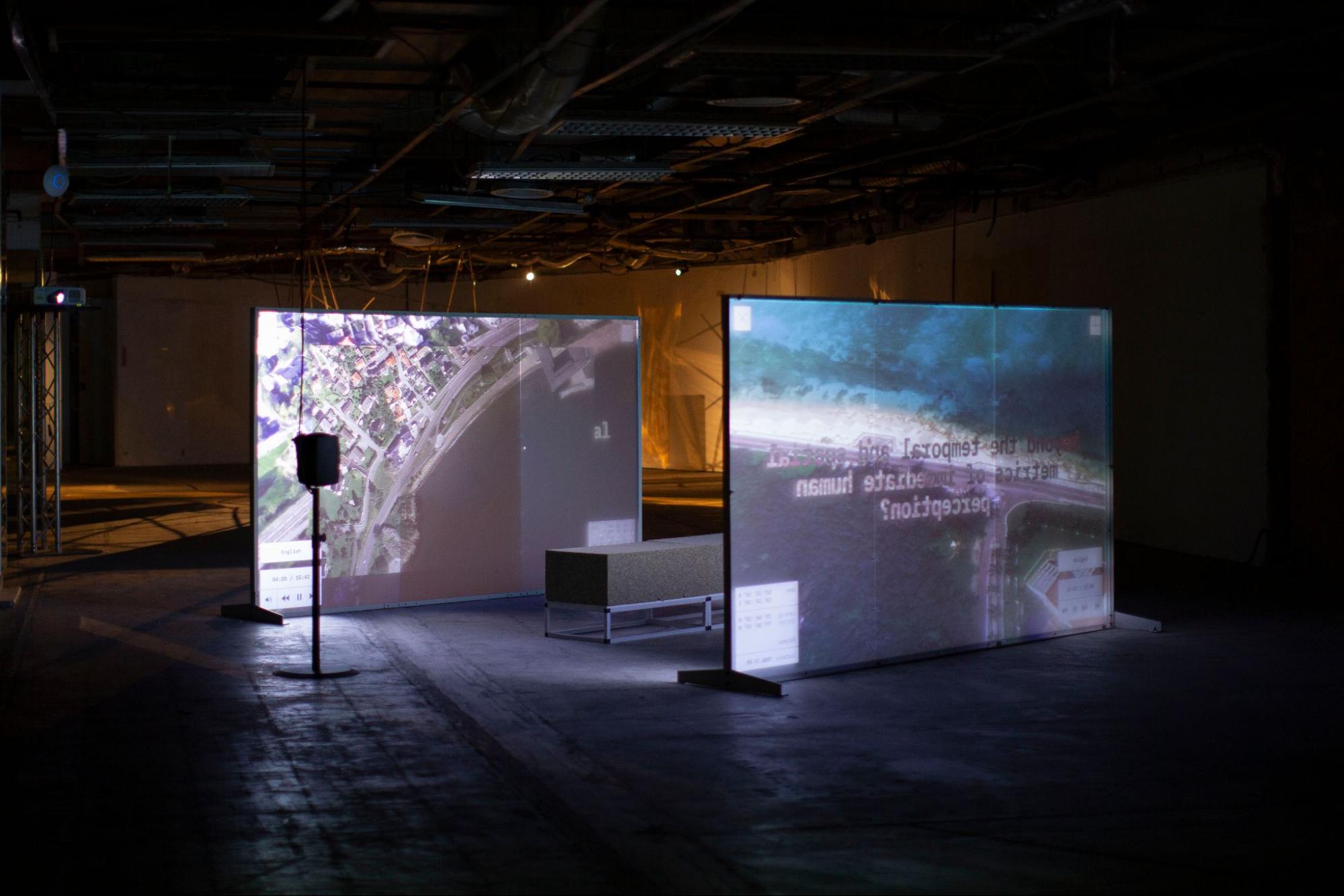
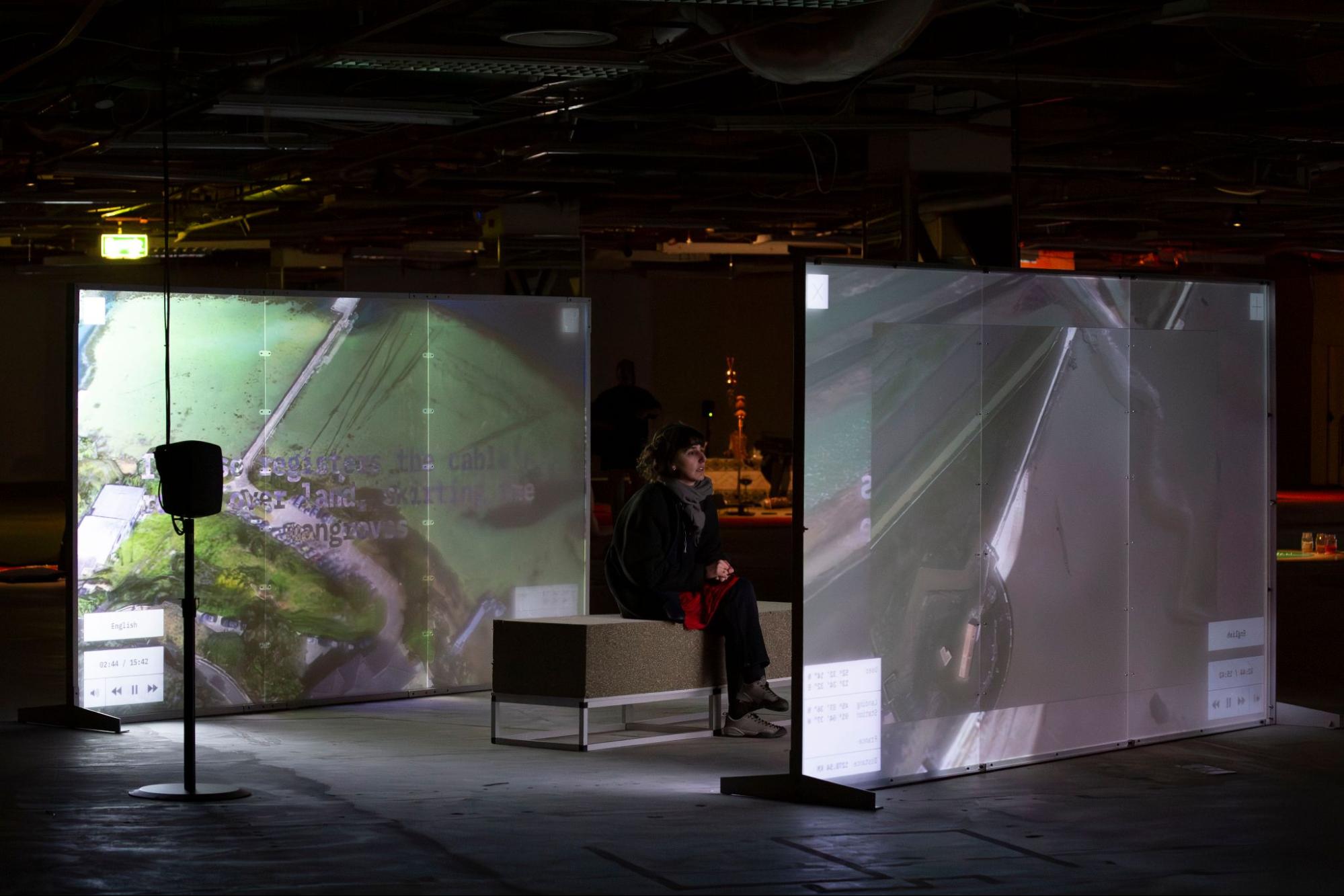
In his 2025 Ocean-Archive.org Digital Residency, artist and researcher Federico Pérez Villoro investigated the hidden locations of these fiber-optic cables in the Caribbean, revealing their specific positions, as well as the webs of geopolitical violence that these infrastructures impose on economically vulnerable places and communities. As part of his residency, Federico co-designed (in collaboration with Tactical Tech's project Exposing the Invisible and TBA21–Academy) Webs of Water, a series of activations as part of OCEAN / UNI's Spring 2025 program, convening a group of artists, journalists, data scientists and geographers to examine and better understand the energy levels and water consumption required to run data servers, as well as the material effects of underwater systems designed to streamline global computation. Recently, a development of his residency project was featured at the 2026 edition of Transmediale in Berlin as a two-channel video projection titled No Distance, publicly compiling the precise locations of the cables' landing points.
Your residency project focused on investigating the entanglements between digital infrastructures and water bodies. What made you interested in the tensions between ecology, technology, and power?
I am interested in the ways in which technical efficiency is imposed upon the forces of life; for example, when a river serves as a national border or when thermoelectric energy is generated by a waterfall. These mechanisms produce complex human paradoxes. The river is unstable as a border, given its persisting transformation, which provides grounds for strengthening this artificial limit by military force. At the same time, the so-called “natural” behavior of the river pushes its technological function beyond the social sphere: the brutality of the border is delegated to its turbulent waters. Such a process of concealment and political convenience becomes ever-present as we operationalize living ecosystems. In this residency, I focused on the algorithmic geographies resulting from the interaction between oceans and the physical implementation of global computation.
Digital technologies, such as the “cloud” or the internet itself, are often thought of as abstract, immaterial entities. How does your project make visible the materiality and injustice behind processes of technological development?
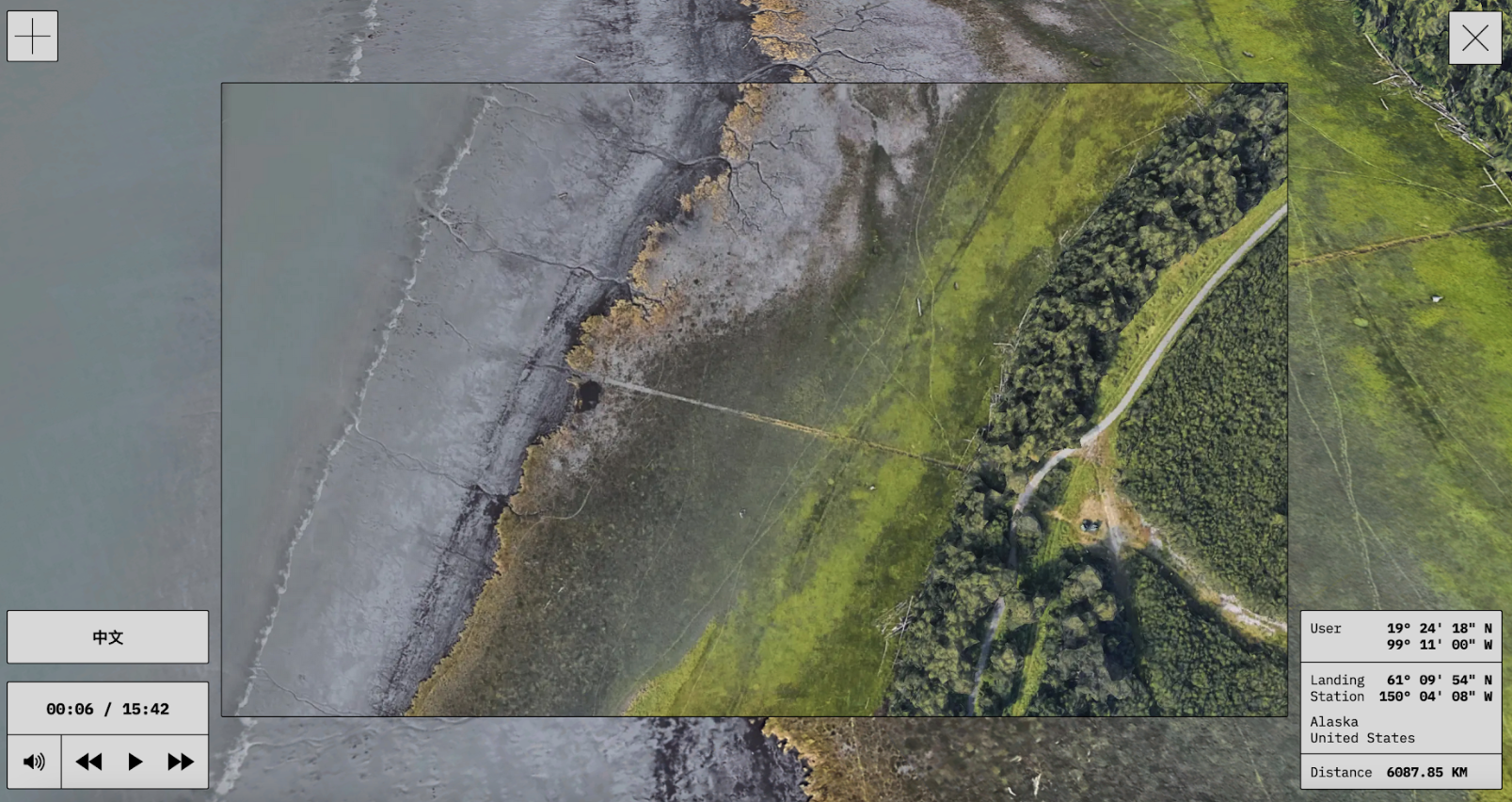
Behind our screens, we assimilate the immaterial fantasy of the internet. Its metaphors soften the friction necessary for long-distance communication. However, data transmission requires physical connections across waters. This project reflects on the socio-environmental impacts of submarine cables and the resulting technical dependencies as yet another strategy for expanding markets. The positions of this infrastructure are government and corporate secrets. The project unveils the precise locations of the cables’ anchor points, the sites where they make contact with land. It portrays how global power is distributed to optimize information transfer while simultaneously extracting local resources to keep the servers running.
Throughout history, the ocean has been a contested space of colonial expansion. What role do oceans and other water bodies play in this “new” form of technological colonialism?
Oceans have been central to colonial ambitions for centuries, the endless horizon of empires’ gaze. What seems different now is how our spatial dynamics towards space evolve in order to make computation faster and the devastation associated with such speed. Massive data centers and their connecting fiber optic network are strategically built around the world as enterprises race for technological dominance. Geography is key to algorithmic efficiency. While colonial reach manifests as territorial growth, resource extraction, and exploitation of populations, private actors also consolidate power through the compression of distance. This is a political geometry of latency at the service of financial transactions and data hoarding for training machines.
What was the most surprising discovery you encountered while developing this project?
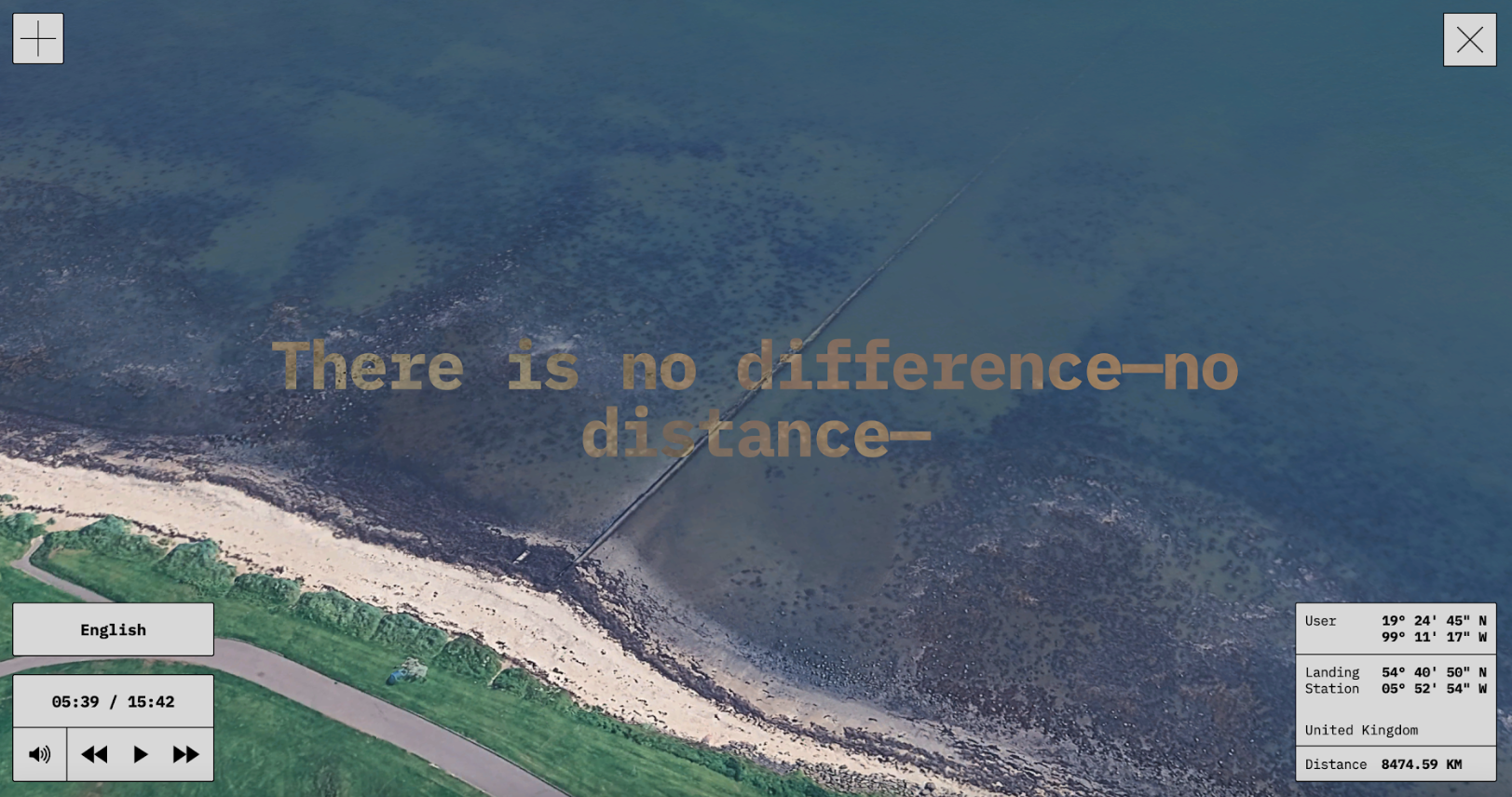
In the process of validating the locations of submarine cables, we realized that their installation leaves a noticeable geological record. This was one of our most important findings and concrete evidence that the coordinates we were gathering indeed coincide with the position of the infrastructure. The project compiles a series of satellite photographs showing the trenches excavated to bury cables underground. Given that the system's locations were unknown, we had not previously seen such an impact. These images allow for a new visual approach to the physical dimension of the internet and a more complete map of how computing power organizes space beyond obvious political boundaries.
Part of the residency involved leading the OCEAN / UNI Activation series. What was the process like, working with a group of researchers and with Tactical Tech?
Our sessions quickly confronted us with the contradiction of meeting online to identify the ecosystemic impacts of computation. Digital platforms enabled our encounters but also facilitated a fragile and incomplete connection with places that are threatened by the same technologies. This condition placed spatial politics and our methodologies at the center of the conversation. How can we connect with distant territories without reproducing flattening representations? Caring for water requires pluridimensional inflections that allow us to simultaneously recognize its material inseparability on a planetary scale without losing sight of the specificity of each territorial, social, and ecosystemic experience.
Laura Ranca from Tactical Tech, with whom we co-organized the series, guided us through open-source conferencing rooms and peer-to-peer cloud platforms. She shared journalistic resources to securely track hidden information online below the surface of commercial search engines. The activations resulted in a collection of essays. Raymundo Vásquez Ruiz, for instance, traced induced political opacity behind energy distribution and data centers in Puerto Rico; Gökçen Erkilic mapped how economic interest and governance interact with deep-sea mining; Rita Costa and Pablo Torres Gómez delved into the financialization of weather speculating on future wind energy industries in the Caribbean.
How did the work evolve for Transmediale?
The piece consists of a two-channel video projection onto semi-translucent panels that generate optical effects of simultaneous opacity and transparency. These surfaces become visible from both sides—a subtle gesture toward the ways in which we configure relationships around screens beyond the more common one-way direction.
Curated by Neema Githere and Juan Pablo García Sossa, this year's Transmediale invited us to recalibrate our internal compasses and to weave relationships aside from technological capture. In this process of reorientation, the festival considered ways to spatialize the traces of our digital lives. My contribution reflected on the instruments that simulate proximity and the material effects of mapping technologies. It aimed to unearth the ways in which habitable places on the planet reconfigure to accommodate capabilities for data transfer.
What role does art play in envisioning regenerative possibilities for ecosocial transformation?
Sometimes art can stimulate sensitive registers and mobilize people's political will. It works through mysterious codes that prepare our bodies for intimate contact with the fundamental forces of life within indecipherable metabolic and emotional scales. However, it is important to consider that in many cases, artistic production serves industries. It operates within the ultimate goals of private and institutional capital. The process of identifying the networks of cables under the oceans seeks to acknowledge our own technical complicity as we search for gaps to defamiliarize ourselves with imposed worlds and the vast systems of value fabrication that perpetuate violence.
Read more about Federico’s investigation on submarine cables in the Caribbean
Read more about the Webs of Water project in the research collection on Ocean-Archive.org.
Interview by Katarina Rakušček