

“Water has memory. We are in it and made of it, edgeless even in border geography.” – Natasha Ginwala
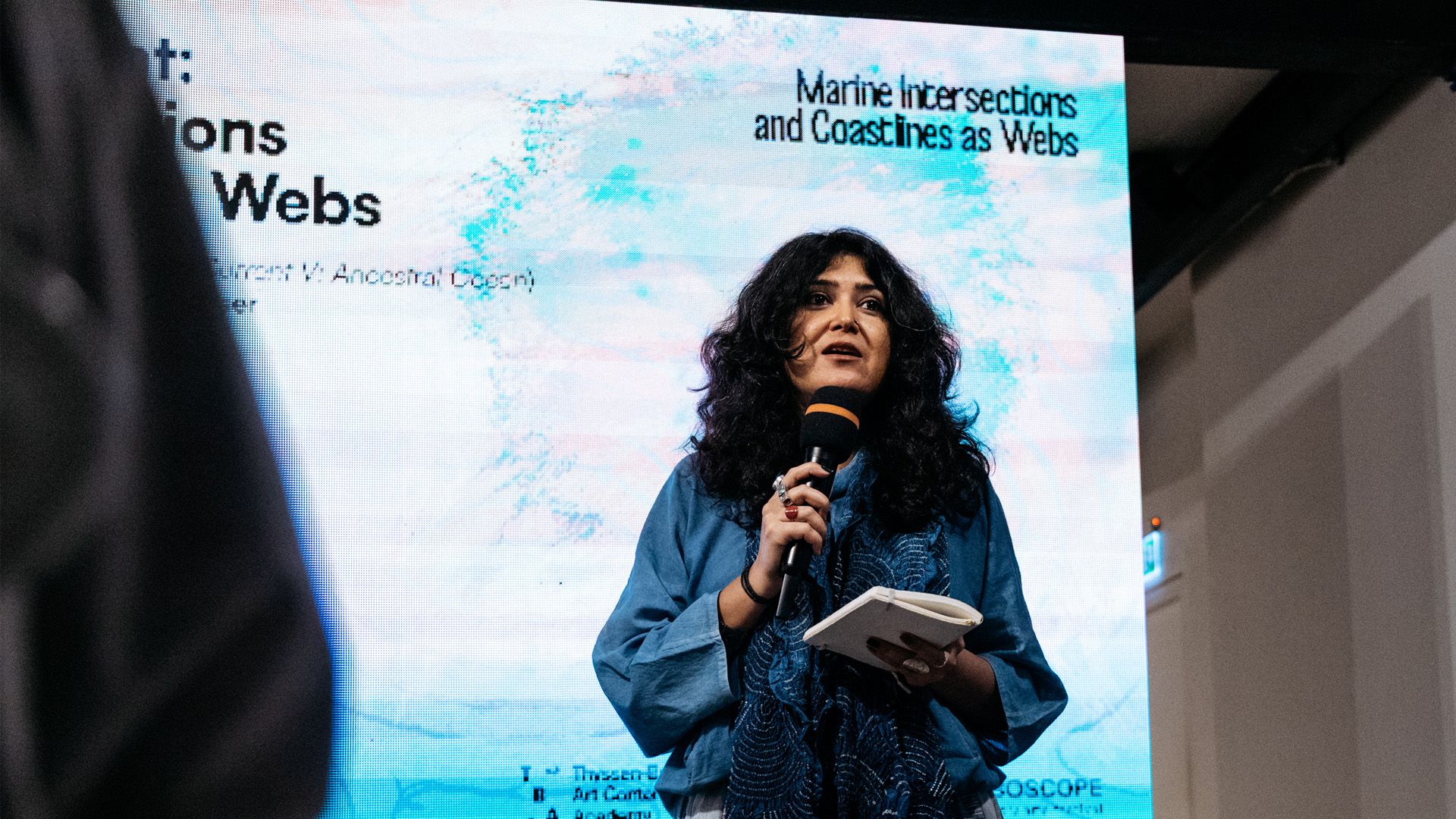
Chronicle of Convening #1: Marine Intersections and Coastlines as Webs
Inaugural convening of The Current V: Ancestral Ocean (2026–2028),
led by Natasha Ginwala
Colombo, Sri Lanka, January 25–27, 2026
How does the Ocean listen? What stories cling to coastlines, to the bodies that inhabit them, and to the species that traverse them? How might the ocean be understood as a living archive, a web of relations, a method for imagining more equitable futures?
These questions shaped the inaugural convening of The Current V: Ancestral Ocean, Marine Intersections and Coastlines as Webs, conceived and led by curator Natasha Ginwala. As an initiative of TBA21–Academy in collaboration with Colomboscope, the convening unfolded within the festival’s ninth edition, Rhythm Alliances: over three days, the coastal metropolis of Colombo became a site of listening, gathering, and collective reflection, where artistic practices, critical thought, and scientific knowledge intertwined to activate pan-oceanic alliances and embodied memories.
The Current is TBA21–Academy's curatorial fellowship program that cultivates transdisciplinary practices and the exchange of ideas around the Ocean and its understanding. Supporting curator-led research and practices, The Current works closely with local practitioners to explore and co-create shared ground across disciplines in relation to the Ocean. Through proximity, collaborative inquiry, and long-term engagement, it strengthens locally-rooted networks while fostering meaningful regional and international exchange.
Living cartographies and Oceanic archives
Water, conceived as a unifying element, constitutes a shared framework – ecological, historical, and political – out of which divergent identities, linguistic expressions, spiritual practices, and multispecies modes of existence emerge. In this context, Convening #1 Marine Intersections and Coastlines as Webs served as a platform for collective thinking, cultivating networks, and building both local and international alliances. The Indian Ocean was approached in an expanded way through the interrelation of art, science, and politics, reflecting on trajectories of movement, displacement, and rootedness, and the ways these histories continue to resonate in the present.
The program unfolded alongside the Colomboscope festival, taking place across multiple sites throughout the city – from art galleries and wetlands to the port – through public and educational initiatives. Within this framework, this first convening brought together thinkers, artists, practitioners, and interested audiences from Sri Lanka and abroad.
The first day, held at Radicle Gallery, began with a presentation by Natasha Ginwala and the screening of nesting (2022), the first video work by artist and performer Fana Fraser. In this short film, Fraser embodies the Yoruba orishas Oya and Oshun in a journey toward the shore, connecting the life cycle of the leatherback sea turtle (Dermochelys coriacea), one of the oldest amphibians still alive, with histories of displacement, dispossession, and empowerment linked to the Middle Passage, placing Black female presence, Afro-Caribbean ancestral knowledge, and Yoruba cosmology at the center. The work activates a key notion of encounter: embodied memories, which inhabit both human bodies and multispecies trajectories.
The session entitled Vessel as Memory. Return as Method convened Wiradjuri and Ngunnawal artist, writer, and curator Brook Garru Andrew alongside Sri Lankan-born and US-based art historian Anna Arabindan-Kesson, under the moderation of Ginwala. Andrew orients his practice toward a critical engagement with contemporary conditions and the enduring legacies of colonialism. He examined First Nations methodologies and the coastal interactions between the Yolngu and Makassar peoples, emphasizing that historical maritime routes function as dynamic networks of living knowledge and channels of exchange.
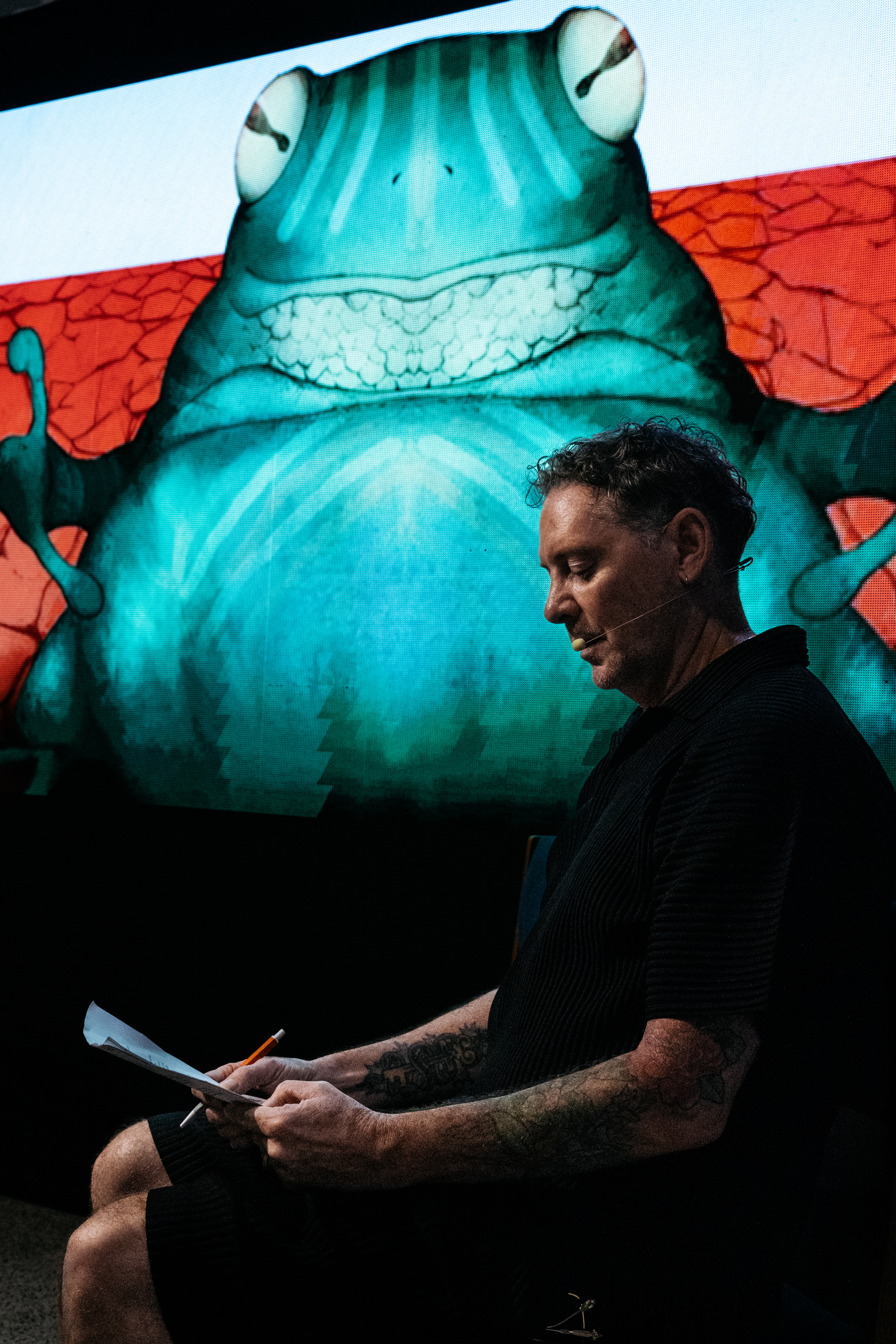
Kesson opened the conversation by drawing on the thinking of French feminist theorist Françoise Vergès – based in La Réunion, an overseas department and region of France – to reflect on “colonial forgetfulness” and the role of art history in producing this form of “amnesia.” Vergès’s theories resonate closely with Kesson’s own practice, which focuses on African American, Caribbean, and British art, with particular attention to imperial and colonial histories, medical narratives, and transatlantic visual culture throughout the 19th century. She pointed out how the movement of textiles and other objects can become a method for returning to histories of ancestral and oceanic connections.
Marine biologist Daniel Fernando, co-founder of Blue Resources Trust, brought science, policy, and conservation into dialogue. Drawing on more than a decade of fisheries monitoring in Sri Lanka – where nearly 70 percent of recorded sharks are rays – Fernando explained how the systematic identification of species can directly inform national and international conservation policies and pathways toward sustainable fisheries management.
Coloniality, infrastructure, and memories
The afternoon continued with On Ports as Portals, Coasts as Companions, a conversation between Laleh Khalili and Neelima Jeychandran, moderated by architect, researcher, and curator Setareh Noorani.
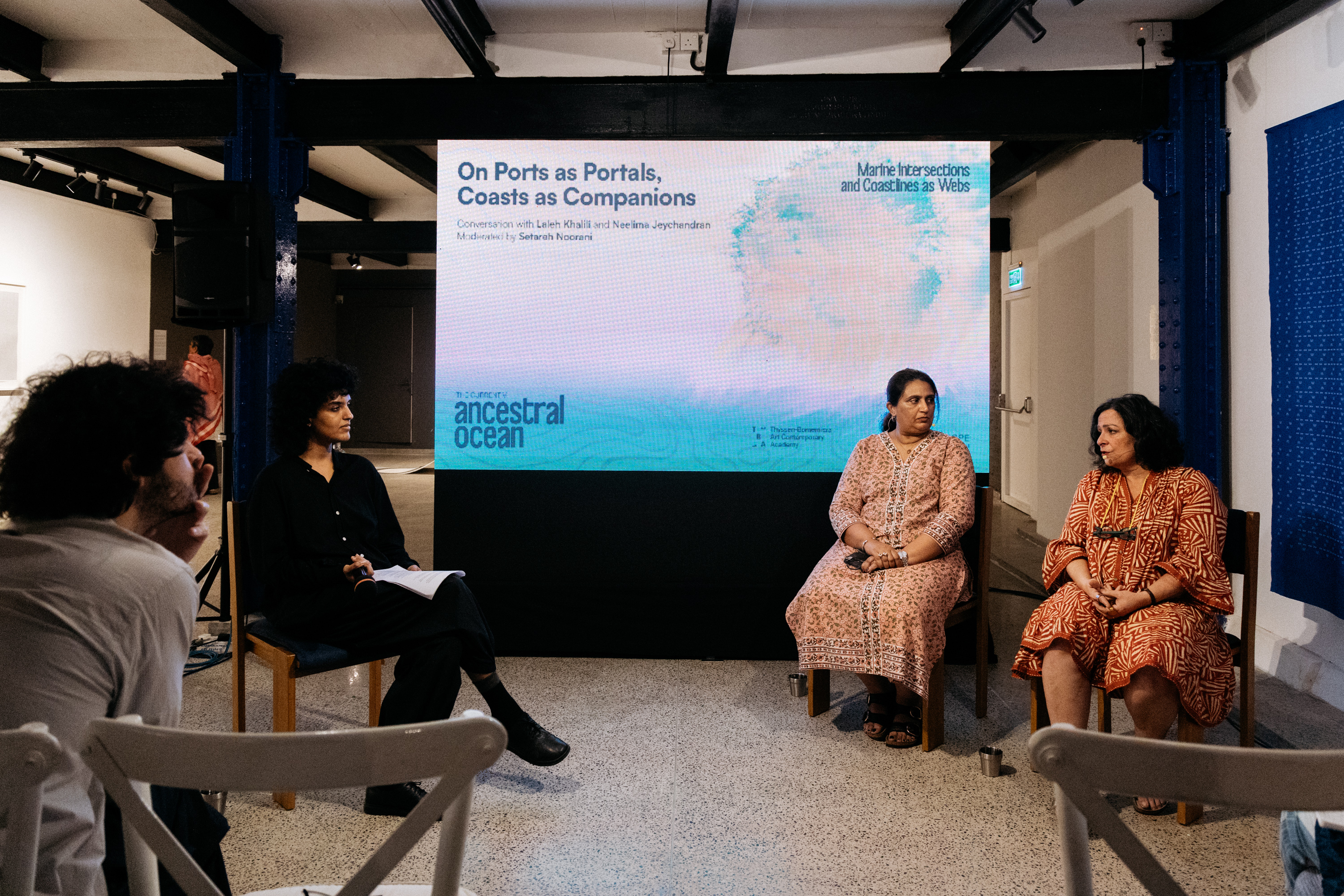
Neelima Jeychandran is an ethnographer, editor, and scholar working on oceanic exchanges and material histories across West and East Africa and the west coast of India, with a focus on object circulation, visual cultures, ritual practices, architectures of memory, and the spatial re-fabulation of the legacies of slavery. She emphasized that the connections between the Indian Ocean and the African landscape are not incidental but millennial, rooted in long histories of trade, itinerancy, intellectual exchange, and seafaring movement.
To narrate these invisibilized histories, she turned to a figure: the Kappiri (or Kafri in Sri Lanka). Brought to Sri Lanka by the Portuguese as enslaved laborers – many stationed in Portuguese and later Dutch forts, others integrated into cavalry units or relocated across imperial networks – the Kappiri embody the suppressed African presence in the region. Through this figure, Jeychandran traced Afro-Asian affinities along the Malabar Coast and beyond, challenging colonial cartographies that isolate rather than connect.
Professor Laleh Khalili reflected on maritime economies and labor networks of port cities, drawing from her recent publications, including her book “The Corporeal Life of Seafaring”, as well as her research on the infrastructures of global commerce. Her research centers on forms of colonialism, particularly contemporary politics, power, and violence, as well as the ongoing violence of imperialism in the present.
Khalili structured her talk in two movements. The first drew from her own ethnographic travels across the Mediterranean, the Red Sea, and the western Indian Ocean, reflecting on the embodied labor of seafarers and the infrastructural architectures that sustain maritime capitalism. The second turned to a Persian manuscript, Safineh Sulaymani (“The Ship of Sulayman”), the 17th-century diary of an Iranian ambassador to East Asia. Written before the Portuguese entry into the Indian Ocean reordered regional power, the text offered an alternative maritime epistemology that situates the ocean as a space of knowledge production, diplomacy, and cosmopolitan encounter.
In a context shaped by militarization, global debt, and the loss of archives, both speakers proposed thinking of the “Oceanic South” as a rhizomatic space of shared histories: a web of devotional bonds, labor routes, and cultural continuities that exceed imperial grids.
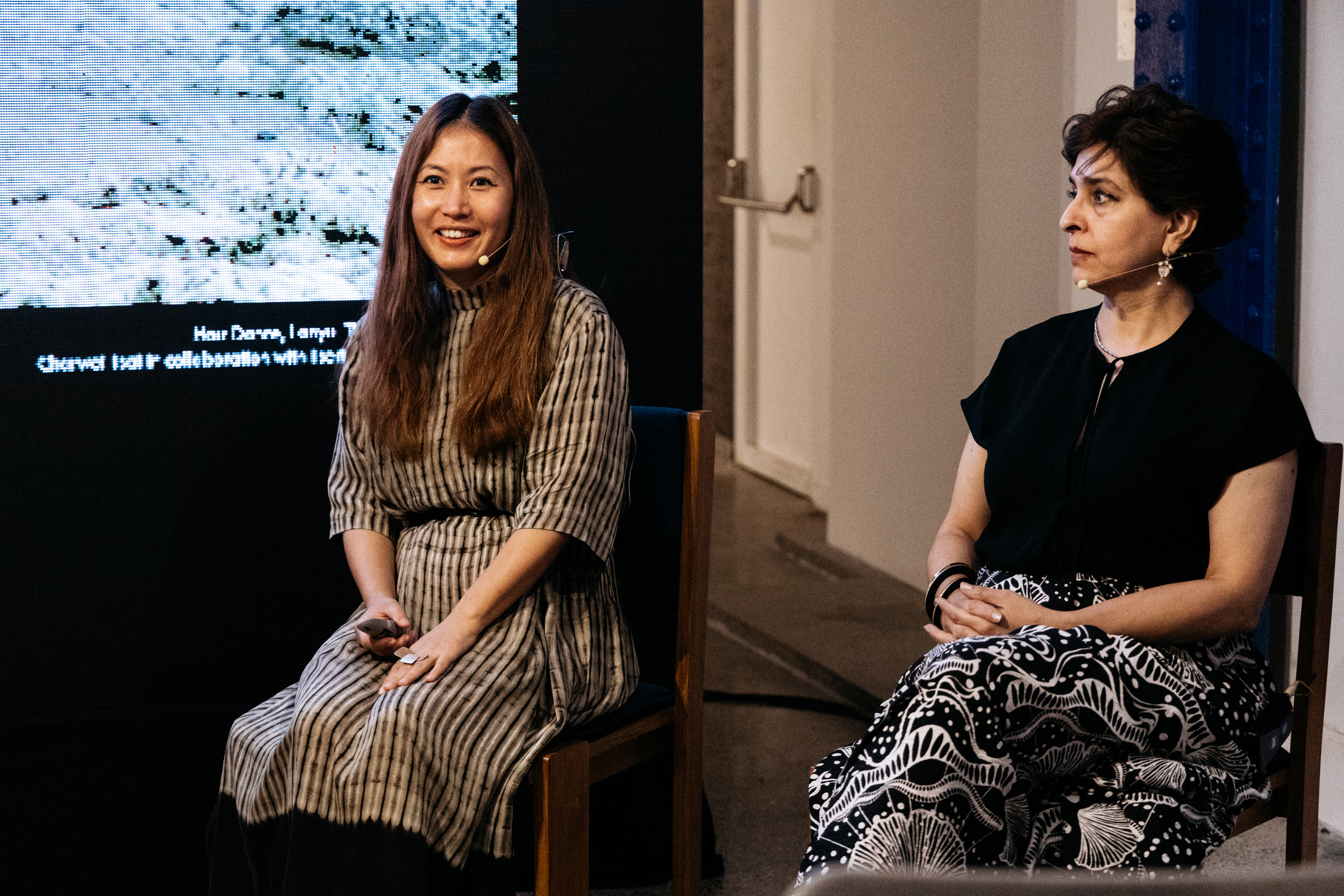
The day concluded with Artist Encounters Across Coastal Spheres, a dialogue between artists Charwei Tsai and Naiza Khan, moderated by Hajra Haider Karrar, the guest curator in this edition of Colomboscope. Karrar is a distinguished practitioner whose extensive expertise lies in the investigation of alternative narratives through artistic practices that engage with the urban landscapes of South Asia. Her curatorial approach seeks to destabilize and reconfigure the colonial and capitalist paradigms that underpin the production and representation of contemporary art. Karrar’s role within the festival functioned as a catalyst for interdisciplinary dialogue, both within Sri Lanka and across the broader Indian Ocean World.
Through diverse media, both Tsai and Khan have engaged in community-centered practices that attend to cultural continuities and histories of dispossession. In doing so, they map dispersed yet interconnected marine intersections through their creative processes, embracing the ocean as a method. The works of both artists were presented in exhibitions across the festival; this prior encounter with their practices offered a more immediate and grounded entry point into the conversation.
Charwei Tsai’s practice connects personal and universal concerns, spanning geographic, social, and spiritual questions, as well as human–nature relationships. Her work engages deeply with East Asian cosmological and spiritual philosophies, human-earth relations, and diverse craft traditions. A screening of Hair Dance – part of a trilogy that also includes Lanyu Seascapes and Shi Na Paradna – explored the relationships between nature, spirituality, and ritual through the study of the Tao Indigenous community of Lanyu Island, Taiwan. Hair Dance focuses specifically on Tao women and their ritual dance, in which their hair is used to evoke the movement of ocean waves as a way of ensuring the safe return of the men of the tribe.
Naiza Khan, a multidisciplinary artist, grounds her practice in critical research, documentation, and map-based exploration. Situated in relation to Manora Island, her work approaches geography as a heterogeneous assemblage shaped by power, colonial history, and collective memory. Through processes of counter-mapping, Khan reimagines the “geometry of empire” as porous and shifting terrains that dissolve into layered histories of water, labor, and resistance.
During the convening, she screened an excerpt from her film Sticky Rice and Other Stories, part of the threefold project Manora Field Notes – Durbeen, Hundreds of Birds Killed, and Sticky Rice and Other Stories –, a homage to the spatial and historical complexities of Manora. Over the past decade, Khan has observed the gradual erasure of the island’s architectural heritage and natural ecology. These transformations mirror, in microcosm, broader urgencies surrounding environmental change, social and economic justice, and large-scale displacement.
The Ship as Microcosm and Sonic Currents
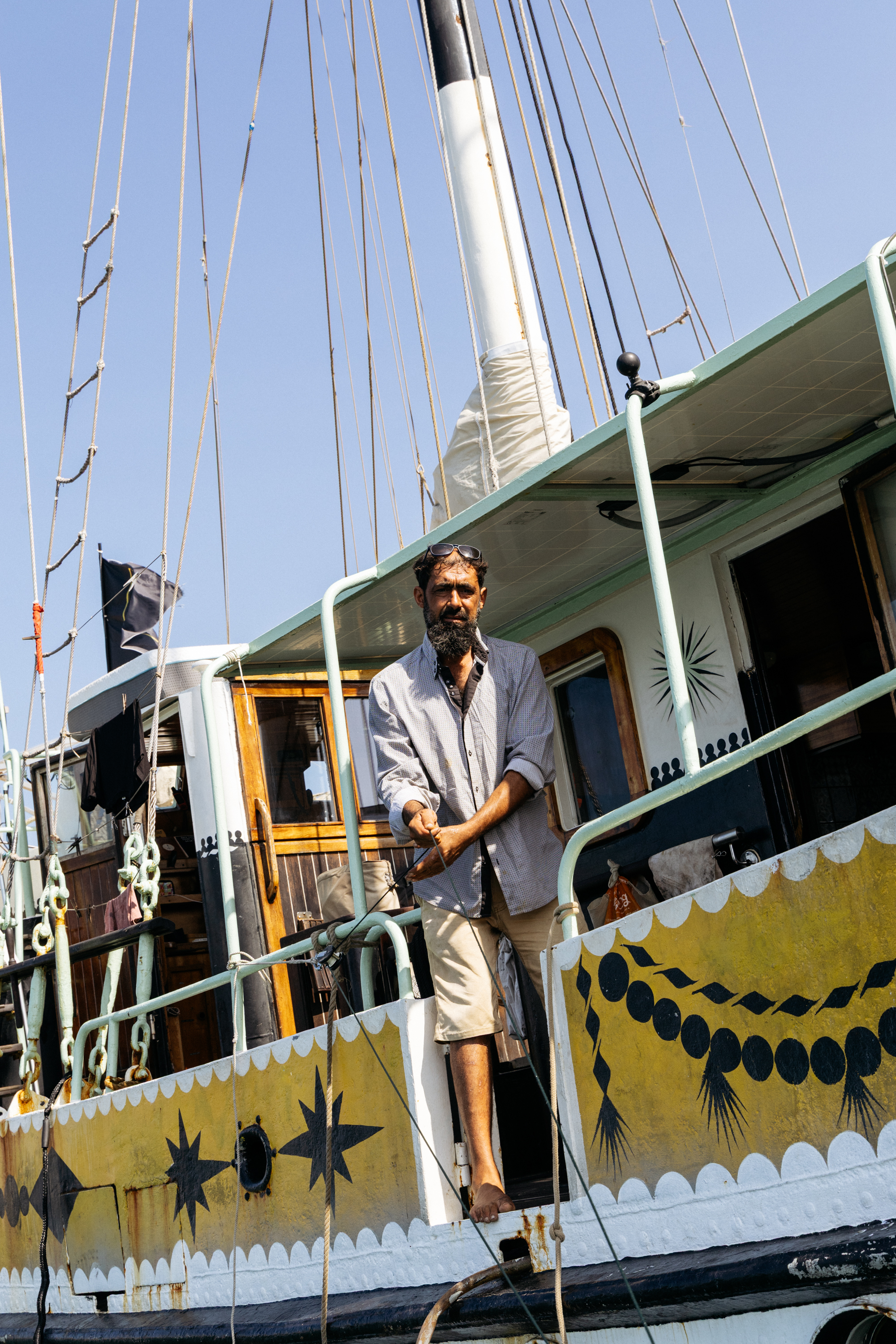
The program expanded across Colombo Port City, Soul Studio, and Musicmatters Soundroom. Arka Kinari: Laboratory of Sustainability took place at the city's port, and invited participants to think of the ship as a self-sustaining microcosm. Conceived and created by musicians and artists Grey Filastine and Nova Ruth, Arka Kinari is an artistic and ecological project that brings together music, performance, and audiovisual projections aboard a traditional sailing vessel. Constantly in motion, the ship promotes climate resilience and a renewed connection to the sea.
Throughout the day, the vessel hosted workshops on environmental sustainability alongside conversations with cultural practitioners, as well as with broader audiences and communities connected to the Sail Lanka Pier. The Sail Lanka Pier holds particular significance, as the port city project has been widely contested by local communities due to extensive sand extraction and the economic debt to China it imposed on the Sri Lankan economy.
The workshops and the performance at Colomboscope are a prelude to their journey across the Suez Canal, leading to the Mediterranean Sea.
Moving to Soul Studio, Atiyyah Khan’s workshop Rotations of Bismillah brought together listening practices, archival research, and DIY methodologies. Atiyyah Khan is a DJ, journalist, and sound scholar of South African and South Asian Indian heritage, based in Cape Town, and co-founder of the music collective Future Nostalgia. Her research focuses on Sufi and traditional music cultures across the African world, tracing how musical forms circulate across continents and within diasporic networks across the Indian Ocean world. During the presentation, Khan guided the audience through her creative process, including collage prints, South African Jazz pioneers, and the spatial politics of apartheid.
Urban Ecologies and Shared Futures
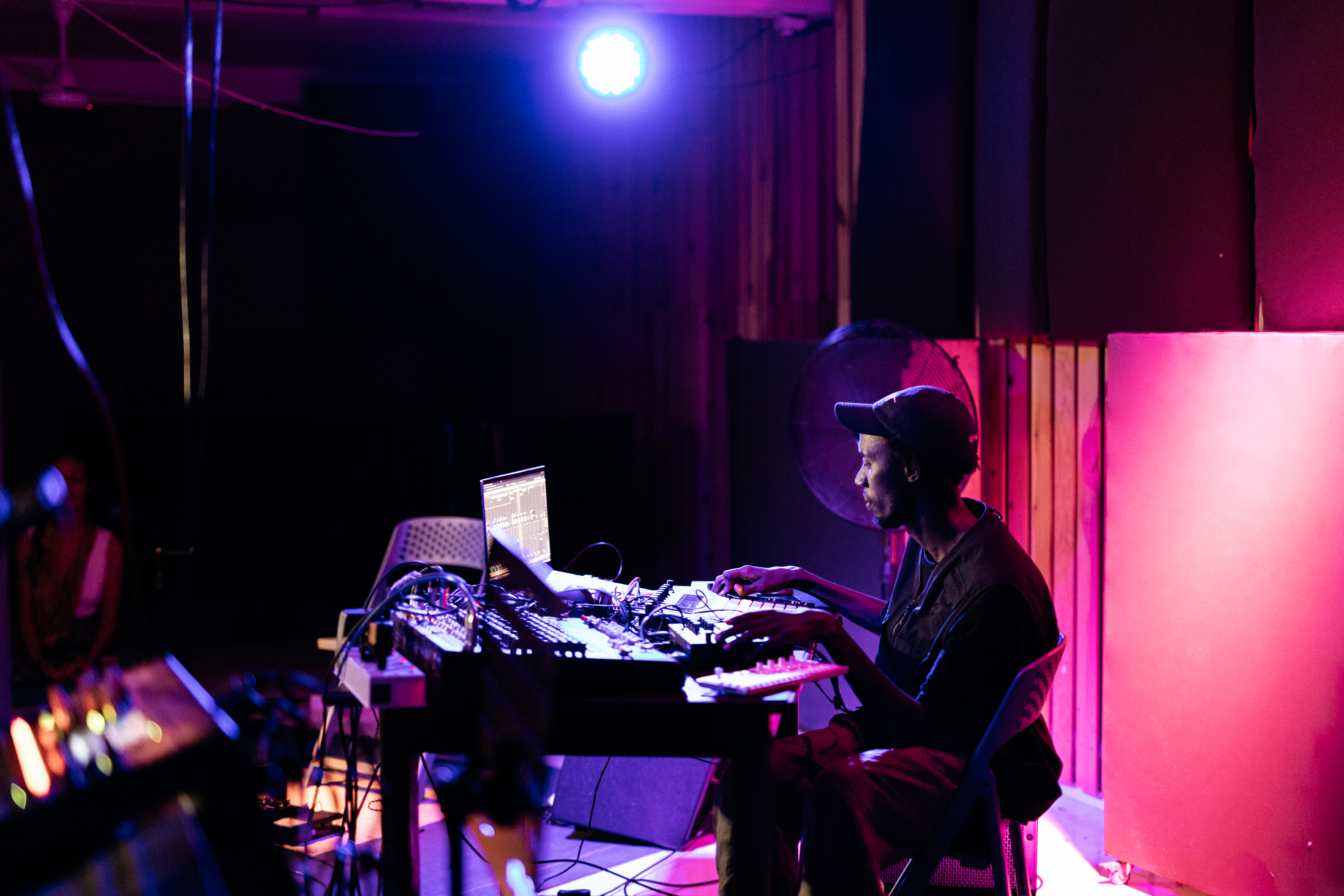
The second day culminated with L25, a performance by sound artist KMRU, an immersive experience based on improvisation, drones, sound collage, and field recordings. His research is focused on mangroves as both metaphor and methodology: a porous framework through which to explore the intertidal rhythms of coastal ecologies, where land and ocean continually negotiate time and human presence. KMRU’s broader inquiry spans ecology and wetlands, city-ecology relationships, community-based sound cultures, and the tracing of connections between Lamu (Kenya), Colombo, and the wider Indian Ocean world.
KMRU’s practice emerges from deep listening and a sustained attunement to the shifting rhythms of environments. He positions listening as both a contemplative and ecological act, approaching sound as a medium through which landscapes, infrastructures, and communal histories resonate, foregrounding acoustic space as a site where environmental awareness and collective memory converge. Conceived as a speculative sonic diary, the piece KMRU showed at Colomboscope embraced opacity and abstraction as critical tools for inhabiting the spatial and temporal dimensions of oceanic contexts.
While in Colombo, KMRU conducted several site recordings in the complex wetland ecosystem of Colombo, including Diyasaru Park, Muthurajawela Marsh – Sri Lanka's largest saline coastal peat bog, a rich wetland ecosystem near Negombo, famous for its diverse birds, mangroves, and unique blend of fresh and saltwater – and the group visit to Beddagana Wetland Park.
All these visits were guided by Amavin Mendis, a volunteer guide of SCAR (Small Cat Advocacy and Research), a non-profit organization established in 2017 and dedicated to the protection of Sri Lanka’s lesser-known small wild cats and other small mammals. The organization works closely with local communities, stakeholders, and government authorities to foster greater understanding and broader public education about these three species through research and conservation initiatives.
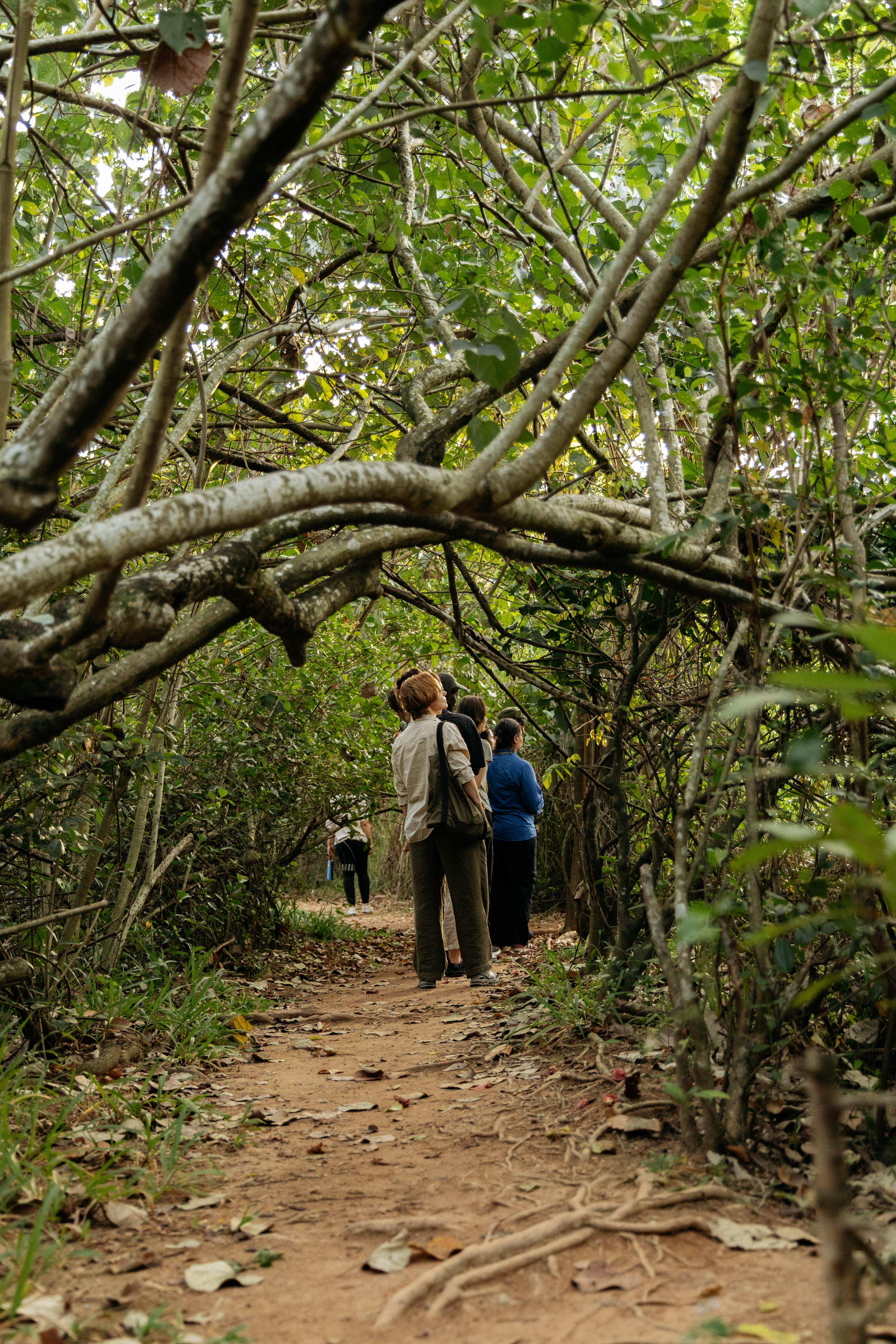
The convening concluded with a walk through Colombo’s urban wetlands, conceived by biologists Anjallee Prabhakaran and Anya Ratnayaka, members of SCAR (Small Cat Advocacy and Research), and founders of Urban Fishing Cat Conservation Project. Home to more than 277 species of fauna and 250 species of flora, these ecosystems function as the heart of the city, foregrounding the reality of urban spaces as multispecies territories. During the walk – guided by Amavin Mendis and Arron Sivaraja –, we were gifted with the sightings of purple swamp hens, white-breasted water hens, lesser whistling ducks, a white-throated kingfisher, and an imperial green pigeon. Among aquatic life, we spotted a snakehead fish accompanied by its young. The area was also home to common crows and butterflies such as the blue tiger, along with a rich diversity of plant life.
The convening consolidated an interdisciplinary platform for exchange that brought together artistic practices, scientific research, and critical thought around oceanic ecologies, while positioning the ocean as a strategic framework for rethinking relationships between territory, community, and sustainability. Conceived as a coming together, it marked the first chapter of The Current V, a curatorial fellowship program led by Natasha Ginwala and unfolding from 2026 to 2028. This fellowship will involve situated research through several field trips across the Indian Ocean region, bringing together artists, scientists, environmentalists, and other cultural actors to join a collective research project unfolding over these three years. Future convenings and a series of commissioned artworks will expand this process of knowledge-building – through texts, talks, and public conversations – culminating in a final collective exhibition in 2028.
Text by Cristina Arnedo
Footnotes
[1] “Hunger ships” is a term used by Laleh Khalili in her presentation to refer to the disparities in food provision between officers and crew aboard ships, as the crew are often fed from the officers’ leftovers. In this context, food functions as a mechanism of control over workers, especially the lascars, who as a result are poorly fed as well as poorly clothed and accommodated, and for whom the rates of illness and death on board are disproportionately high.

The Current V: Ancestral Ocean
Convening #1: Marine Intersections and Coastlines as Webs
25 January – 27 January 2026
Learn more
The Current V: Ancestral Ocean
Discover the new cycle of our curatorial fellowship program; a pioneering initiative that cultivates transdisciplinary practices and the exchange of ideas around the Ocean and its understanding
Learn more
The Current V: Ancestral Ocean
Flotation #1: Listening into Waterways
29 August – 6 September 2026
Learn more